Tuesday, February 26, 2013

Interview on Nutrition with Mr. South Africa Elton King Horn. By Vic Goyaram

Interview on Nutrition with
Mr. South Africa Elton King Horn
By Veeraj Vic Goyaram, Cape Town, South Africa
The thing that Elton does the most besides eating and training is smiling
A very old pic of Elton and yours truly at work
Elton Horn has been a good friend of mine since I came to South Africa. Besides being one of the finest bodybuilders that South Africa has produced, Elton is also always ready to share his bodybuilding experience. For several years I have been working my part-time job at Dischem Pharmacy in Claremont, Cape Town where Elton is the Supplements Manager. There talking and advising on bodybuilding is our job and indeed something we never get tired of. Today I am pleased to bring you an interview with Elton to discuss bodybuilding nutrition with lots of advice for beginners and those wanting a close look of how an elite athlete of the sport eats to fuel his body. You will also get to know more about Elton, his bodybuilding background and his plans for the future. Many people, including myself who know Elton personally believe that he has the physique to be a successful 212 division professional bodybuilder.
Balance is the name of the game
Vic: On behalf of Bodybuilding Mauritius, thanks very much "brather" Elton for taking the time for this interview. We appreciate it very much. For those who don’t know you can you please give us a little background on yourself?

Elton:  Always a pleasure Vic! Hello everyone out there. I'm glad to be doing this interview and I hope that you will benefit from my tips to follow. Well, my odyssey into the muscle world started in 2002 at the age of 19 when I started training for bodybuilding. I have been very successful as a skater in my teens and it kept me always very active and lean. It did not take me long before I jumped onstage in 2003 and so far I have done 27 shows in 8 years. I work as a supplements manager and consultant and I also do stunts for Hollywood movies. 
Elton, the movie stuntsman on a filming set
Vic: Aweh, I know about Elton the Stuntsman. Tell us which movies you did.

Elton: I have done six movies so far. My most memorable one is when I was the stunts double for famous American rapper LL Cool J. I also played in the “Scorpions King” movie which I really enjoyed.


Vic: What are the highlights of your competitive career and what are you currently up to bodybuilding-wise?


Elton: I enjoyed every single show I entered but cherish my victory on my competitive debut in 2003 at the Cape Town Classics where I won the Junior Overall title. The same year I went on to win the junior overall at the SA Novice Champs. My best moment so far remains of course my heavyweight and overall title at the 2010 WPF Mr. South Africa. I have also won the popular Shameen Classics 3 times before winning the SAs.  I have since taken a layoff and I am making my comeback soon. 
Elton's competitive debut in 2003 as a junior
The Cape Town Classics where he won the Jr. Overalls
Vic: Let us get to business! Elton, in your capacity as a supplements manager and consultant, what is the most common nutritional mistake that you find most beginners make?

Elton: Indeed Vic, in my several years working in supplements I have seen that most beginners tend to view supplements as an alternative to eating rather than something that goes hand-in-hand with eating. It is not uncommon to see a beginner getting a mass builder supplement and then decide that’s the only thing he will ingest. Another mistake I see, especially among hard gainers, is under eating and thus insufficient intake of calories. They commonly overestimate their food intake but when you analyse their diet you see that it is largely insufficient and often filled with empty calories. Similarly, many overweight beginners are also not getting nutrients in the right ratio for their bodytype.  I have seen very many people walking into the store and looking at supplements even before having started training!  I agree that these guys can't know everything at once and it is my job to help them get started.
His early competitive days
In one of his 3 Shameen Classic wins
Vic: Certainly, supplements are everywhere on the Internet, magazines. But what would be your nutrition advice to those starting out and still wanting to use supplements? 

Elton: I advise setting a goal first of all, be it fat loss or mass gain, and then start planning your nutrition according to those goals. Use supplements that will help you achieve them. Always think in terms of a diet program as a foundation on which a supplement program may be added to. The supplements are only useful to fill “gaps” in your nutrition program. Always prioritize feeding! Then again when including supplements, stick to basics like protein which is one of your most important macronutrients. Do not worry about pre-workouts and testosterone boosters and rather spend your money on protein. Other supplements come later. Your main concern should be to ensure your quota of macronutrients according to your goals. You may take the best creatine, pre-workouts and boosters but you aren't going anywhere if you are not ensuring the proper intake of macronutrients. Also, it helps to empower yourself in terms of knowledge on training and nutrition by reading books, magazines, asking experienced people and visiting trusted websites like Bodybuilding Mauritius that I myself enjoy. 
About to pump up before going onstage at his last show
2010 Mr. South Africa
Vic: What supplements do you currently use?

Elton: I always diet very strict and my offseason diet does not deviate much from my pre contest diet. I get only about 5kg heavier offseason. I still eat very clean in the offseason and the only change I bring in my diet is the addition of two home-made mass builder shakes to my 5 solid meals. I do not believe in eating unhealthy in the offseason under the pretense of gaining mass.  Supplement-wise I use a whey protein, BCAAs, multivitamins and flax seed oil.
Food is your main fuel for the body
Vic: Home-made mass builder shake! I always preach that. Do you mind giving us the recipe?

Elton: This shake is called the M3 (Mitchell’s Plain Muscle Machine) mass shake, in tribute to where I am from (Mitchell’s Plain, Cape Town). It consists of 50g whey protein powder, 150g oats, 2 tbsp flax seed oil, 15g Goji berries and 10g BCAA. I drink this shake twice a day, as breakfast and then again postworkout (minus the flax seed oil).

Vic: I also see that you like intraworkout drinks. Do you mind again telling us what’s in your gym water bottle?

Elton: I got this recipe from you. You call it the “Vic Intrabolic” if I remember correctly. I believe a lot in intraworkout nutrition which keep my muscles fueled up while training. I feel fuller, more energetic and get better pumps during my workouts. This intraworkout drink contains medium GI carbs and BCAAs, with extra L-Leucine thrown in. How much I consume of these is dependent on the task at hand. On a leg or back day, it’d down 100g carbs and 10g total BCAAs in order to get through those gruelling sets of squats and deadlifts. On other days I stick to 50g carbs and 5g total BCAAs.
Intraworkout drinks keep me full during my workouts
Vic: I see you are very dedicated. I have never seen you without your lunch bag. You brought it I remember 2 years ago even when going to the nightclub after we went to see the Western Province bodybuilding show together. It was full of rice and chicken breasts. How important is meal planning to you?

Elton: Laughs! I am lucky because my mother cooks for me but then I don’t give her too much trouble. So my food is basic: chicken breasts, brown basmati rice, and broccoli all year long except for Christmas family get together. I will substitute the chicken for beef in only 3 meals in a week.  For me food planning is as important as planning your training when you go to the gym. If you go to the gym without a battle plan you will catch up on nonsense while training. You don’t leave for a trip in your car without fuel in the tank either. On days I work I will pack all my meals for the day in the morning. On days I am off if I know I will be out of the house for more than 3 hours I always pack something to eat. For me food is very important and accounts for the majority of my bodybuilding expenses. 
Elton and his food bag are inseparable. He never came to work
a single day without it. SERIOUSLY.
Vic: Can you run us through a sample daily “offseason” diet, meal by meal?

Elton:
Meal 1 (9am): M3 mass homemade mass gainer
Meal 2 (11am): 200g chicken, 100g brown rice, 1 cup broccoli
Meal 3 (1pm): same as meal 2
Meal 4 (4pm): same as meal 2
Training (6pm): Intraworkout drink
Postworkout (7:30pm): M3 mass gainer (minus flax seed oil)
Meal 5 (8:30pm): same as meal 2
Meal 6 (11pm): chicken only (200g)
One of Elton's 5 solid meals of the day. Keep it basic! Chicken, rice and brocolli. He uses Mrs. Balls chutney sauce to add some flavour
Vic: Elton, when are we seeing you again onstage and what are your goals and what will fans see new on Elton next time around?

Elton: I think I have done a lot of contests already in South Africa and I want to compete internationally.  I intend obtaining my qualification for the BBSA (IFBB) Nationals by doing the BBSA Western Province championships and then hopefully obtain my ticket for the World Amateur Championships.  I would like to work more on proportions by bringing up my hamstrings and calves to the same level as my overpowering quads in order to maintain the balance.  At my last show in 2010 I was 96kg (211lbs) onstage. My goal is to stand onstage at just under 100kg (220lbs) with great condition.
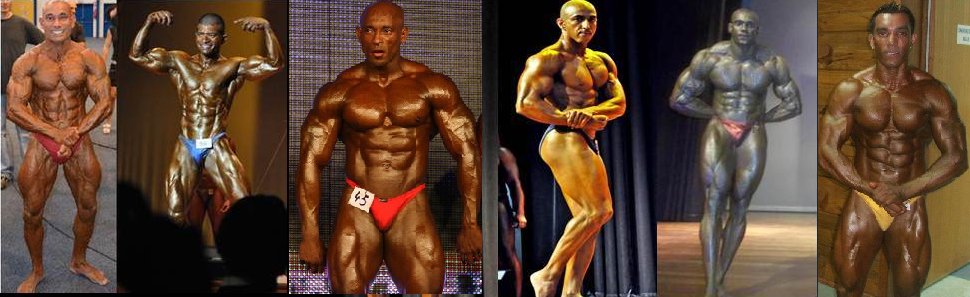
Elton's showstopping physique at the 2010 Mr. South Africa
Vic: Good luck towards that, bro. All your fans want you back onstage and we are sure you that they will get their patience’s worth. I can see you have a lot of fans especially on AfricanMuscle.com? Any message for them and Mauritian fans?

Elton: Thanks, brather Vic. I will do my best. Yes, I like checking Bodybuilding Mauritius and Africanmuscle.com. It is definitely a breeze of fresh air on the online community as I see that many websites are more commercially oriented. I see that I am up in a contest on Africanmuscle.com for African Bodybuilder of the year 2012. This website is very well organized and I am amazed to see the amount of talent in other African countries.  It makes me proud to be African. Bodybuilding Mauritius is up there too and loaded with great advice and regular updates. I am very impressed by Mauritian bodybuilders as well. I wish to say thanks to everyone and don’t give up on your dreams.  Coming soon will be a training article where I will share my best training advice with you. I am glad to be among you. Hopefully I can come to Mauritius one day. Vic's dream is the "Bodybuilding Mauritius Pro Grand Prix", I know.


Vic: Thanks Elton. Bodybuilding Mauritius is just a blog website and we take great care to load it with information. This is just a start for better things ahead. We are planning to get “bodybuildingmauritius.com” website for 2013  where there will be forums, galleries, our own training videos and lots of articles properly organized. This will be my gift to the Mauritius Bodybuilding community. Thanks for this interview Elton. It is much appreciated, bro!

Elton: The pleasure is mine. Good luck with your website. I have no doubt it will be great as it is from you and people with good intentions. 


More pics of Elton
Monster back


CLEARING SOME COMMON MISCONCEPTIONS ON BODYBUILDING. By Ajmal Arab

CLEARING SOME COMMON MISCONCEPTIONS ON BODYBUILDING

By Bodybuilding Mauritius member Ajmal Arab


Bodybuilding is NOT just a sport, it’s a lifestyle. You need to train, eat the right things in the right amount and rest!!

• Bodybuilding is NOT weight lifting!!! It’s not about lifting the heaviest weight you possibly can, its having the best body you possibly can.

• Bodybuilding is a lengthy process, you don’t become Arnold overnight!! People expect to go to the gym for a few weeks and come out with six packs, huge chest and biceps. Man, bodybuilders like Coleman, Cutler and Heath has been training since their adolescence and it’s in their thirties that their body is peaking. It takes years and years of hard work!!

• Bodybuilding is having the best body you can possibly achieve. Not everyone will become Mr. Olympia, Mr. Universe or Mr. Mauritius!!! But when you will look at the mirror and compare yourself to how you were before, you will see improvement in your body. Some people will tell you, ‘look at that guy he doesn’t go to the gym but he look better than you’. Man, some people are born rich and some are born poor. The poor one have to work hard in order to be rich and maybe he will never be as rich as the one born rich, but he’ll be richer that when he was born. Bodybuilding is just like that, some people are born with six packs, some people have to work hard for it and he may never attain it but at least he’ll have a two pack.

• Mauritians have the opinion that guys who go to gym are arrogant or they show off by pushing their chest or have wide arms while walking. It’s not that. Man, that’s not show off or being arrogant!! It’s just that his chest and lats is pumped!!!! And if he walk like that he is doing is unconsciously, not for show off!!!
• If someone looks good with huge chests, arms and legs, people think he is on steroid. Man it’s years of hard work, sacrifice and dedication. Just stay at home and inject yourself with steroids, then see your body!!!

• People think that when bodybuilders become old, they will look bad. Man, just taking an example of Salman khan who everyone knows. He is not a professional bodybuilder and he is nearly 50. He may not have the best body he ever had now, but he still looks good. See any average people at 50 and see any bodybuilder at 50. I guarantee you that the bodybuilding will look at least 10 year younger!!

• People think that if you stop bodybuilding, you will have a big belly. It’s never like that, if you used to be small before you started, you will tend to become small again and if you used bodybuilding to lose weight, you will naturally gain weight. You will only tend to become what you originally were!!

• Some people will tell you so many years you did bodybuilding and you look the same. I tell you if you did not do bodybuilding, you would look lot worse than you actually are. It’s just that you are maintaining your body!!

• People will tell you ‘how can you eat that?? Why can’t you eat like a normal person??’. Just tell them to shut up!!! We’ll see when you grow older who is he healthier and have a better body.

Brothers of iron, people will tell you lot of thing for you to quit bodybuilding, but you just concentrate on your objective and achieve it!!! THEY ARE JUST COWARDS AND JEALOUS OF YOU!!!

They can’t put on the hard work, do the sacrifice and have they dedication like us but they don’t want us to have our best body!!

Always remember: THERE ARE MILLIONS OF REASONS FOR YOU TO QUIT, BUT THERE WILL ALWAYS BE ONE REASON FOR YOU TO GO ON!!!

La nécessité de la répartition de l’entrainement et son impact sur le repos. Par Jimmy Shibduth


La nécessité de la répartition de l’entrainement et son impact sur le repos
Par Jimmy Shibduth

Comment doit-on envisager le repos lorsque l'on veut progresser en culturisme?

Entrainement, repos et nutrition composent la sainte trinité de l’homme en parfaite santé. Effectuer l’un sans l’autre revient à sauter en parachute en le laissant malencontreusement dans l’appareil.

Après de nombreuses années de pratique, ce que j’ai remarqué, c’est combien le repos était soit mal compris, soit totalement ignoré. Or, comment peut-on espérer tirer le meilleur parti de son corps si celui-ci n’est pas totalement régénéré ?

 L’erreur la plus courante est celle faite par les « lecteurs ». En effet, cette catégorie de « théoricien » du culturisme a la particularité de croire qu’elle sait tout. Elle lit (vaguement) des « Ã©tudes », qui quelques fois ont plusieurs années et on été démenties, et vous rabâche (en partie) ce qu’elle a retenu. Par conséquent, ces éminences grises n’hésitent pas à vous affirmer que vous pouvez vous entrainer tous les jours, à partir du moment où le muscle s’est suffisamment reposé (48 heures pour les plus mauvais, 72heures pour ceux qui ne lisent que la moitié des choses et entre 48 et 72heures pour les mieux renseignés ; eh oui, vos muscles n’ont pas tous besoin de 72h, certains peuvent se contenter de 48).

 Cette méthode, très en vogue dans les années 70, les « années Schwarzy », a depuis longtemps été revue et corrigée. Déjà dans les années 70-80, Mike Mentzer qui préconisait une série effective poussée à l’extrême par exercice. Alors que les séances de l’ex gouverneur duraient 5 heures, celles de Mike Mentzer duraient 40min tout au plus. Je vous invite à regarder les photos. Certes la génétique est pour beaucoup dans le résultat, mais je laisse l’argument de la génétique aux gens qui pensent que c’est une excuse…

 Toujours est-il, en effet, qu’en culturisme, la division de l’entrainement est fréquente et très répandue. L’idée, c’est qu’à chaque jour correspond une ou plusieurs parties du corps. A mon sens, la répartition est une obligation du culturiste amateur ou confirmé. Sinon, le matraquage systématique de la même zone du corps, jours après jour, risque fort de décevoir ses partisans en termes de résultat visible…

 Pour autant, répartir son entrainement afin d’arriver à 72h de repos par muscle et recommencer immédiatement le cycle est une erreur. En effet, les partisans de cette méthode ont oublié un facteurimportant: le facteur global. Le corps humain n’est pas simplement une accumulation de parties qu’il suffit de laisser reposer tour à tour. Au contraire, il s’agit d’un tout et il convient de le laisser se reposer tour à tour et dans son entier. Par conséquent, il faut veiller à ce que les muscles aient, au moins, 72heures de repos et que le corps en entier ait des journées de récupérations entières.


C’est sur la base de ces hypothèses que beaucoup ont divisé leurs entrainements. A mon sens, toujours, c’est la meilleure chose à faire. Si certains ont du mal à changer leur niveau de répartition en semaine, certains arrivent très aisément à penser en cycle. Je m’explique. Pour la plupart des pratiquants, un cycle équivaut à une semaine. Or, à part votre cerveau, aucune partie de votre corps n’est capable de savoir qu’une semaine s’est écoulée depuis la dernière séance…

Toujours est-il que, pour permettre une récupération suffisante, vous pouvez opter pour une répartition simple :

Lundi et mardi : musculation

Mercredi : repos

Jeudi et vendredi : musculation

Samedi et dimanche : repos

 Vous pouvez opter aussi pour une répartition en termes de jours et non de semaine :

Jour 1 et 2 : musculation

Jour 3 : repos

Jour 4 et 5 : musculation

Jour 6 : repos

Jour 7 et 8 : on recommence le cycle.

 Je vous propose, à titre d’exemple, ma routine de travail actuelle (mais je la change très souvent) :

Lundi : Jambes et mollets

Mardi : pectoraux et biceps

Mercredi : repos 

Jeudi : dos et abdos 

Vendredi : Ã©paules et triceps

Samedi et dimanche : repos.

 A vous de jouer !

Jimmy SHIBDUTH pour Bodybuilding Mauritius

Mastering the Art of Posing. By Vic Goyaram


Mastering the Art of Posing
Researched and composed by Vic Goyaram
With personal inputs from several competitive bodybuilders 
The importance of posing
You have spent years constructing your physique and you must know how to show the fruits of your hard labour. Whether you are showing your physique to judges on contest day or simply posing in front of your friends at the gym, you should know how to display your body properly.

A great poser is not only one who can do break dances, robotic moves or a full split while still showing his muscles. A great poser is someone who can use posing to his best advantage, to show his strengths and hide his weaknesses to create an illusion of, for example, greater mass or greater shoulder-to-waist differential.

The Power of Illusion
How many times have you seen a well developed bodybuilder “die away” in a lineup because he cannot pose properly to display his muscle? I bet quite a few times and this is really a pity. I have personally seen  massive bodybuilders looking really good when relaxed but look bad and awkward when starting to pose. I have also on many occasions seen competitors looking rather mediocre or blocky when standing relaxed but look startling and much bigger as soon as they start hitting poses.

Gentlemen, FLEX!!
In this series on posing I will show you the mandatory poses, what the judges are looking for in each pose and my personal notes on how to highlight your strengths, hide your weak points and what to avoid doing in each pose.  I will also show you pictures of how bodybuilders slightly “manipulate” each mandatory pose to their advantage. You will be stunned by the number of variations to each pose that bodybuilders use. For instance, Arnold, Kai Greene, Frank Zane and Toney Freeman each hit the front double biceps differently.

Bottom line is bodybuilding is an exhibitionist sport and bad posing can “wreck” your physique.
  
Mandatory Pose 1: Front Double Biceps

How to hit the pose properly
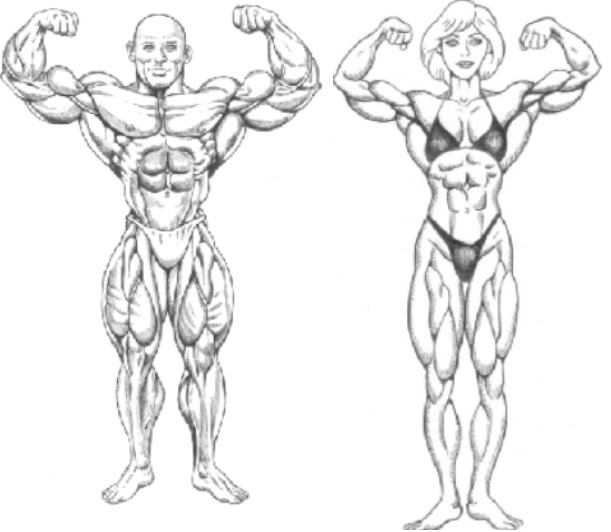
Balance bodyweight evenly on both legs.  Legs should be slightly bent at the knees. Do not keep the knees straight. Flex the legs hard to show separation. Do not put your feet straight forward. Point your feet outward (see picture above) as this will allow you to show separation in your legs and also your calves. Keep the stomach tight and under control at all times. Raise your arms to hit a double biceps position. Raise arms to about shoulder level. Neither too high nor too low. Flare your lats as you raise the arm. Supinate your wrists (hands turned toward you) to show the biceps peak

What the judges are looking for in this pose and what you should do to make them happy

The first thing that will capture the attention of the audience and the judge is your midsection. Make sure you are in good condition and have the proverbial “washboard abs” before you step onstage. If your condition is off it will show very prominently in the midsection.

The judge will perform a head to toe survey of the body, looking for overall muscle density, balance and definition. The judging panel will analyse the following areas of the body for the points mentioned:
  
Arm development: whether or not there is sufficient biceps development and a good balance between the biceps and the triceps  Biceps peak are a plus point as well as the split between the two heads of the biceps.

Chest, shoulders, lats and serratus: Whether or not there is balance between the chest and shoulders and the arms. The arms should not overpower nor be overpowered by the chest and shoulders. Take a look at Branch Warren (pictured below)  and you will see that his arms are overpowered by his thick chest and shoulders in this pose. Extra points are scored if the lats flare out well and the serratus muscles are visible.

Midsection: The midsection receives a lot of scrutiny in that pose. A bad midsection (more often a result of insufficient dieting and substance abuse than bad genetics) will ruin your front double biceps. Maintain the abs tight at all times.The judges look for abdominal control and whether or not the internal obliques show above the hipbone. You score more points if you can flex your abdominals along with the rest of your body (see picture below)

Legs: The judge will look for leg development, not only in terms of size but also in terms of separation  and balance. How well you can show the various muscles in the legs and how visible they are will also depend on your conditioning. If you show good adductor development you can spread the legs slightly more to showcase them (see Branch Warren in the picture below) and this will earn you extra points. Many competitors focus only on showing the teardrops and not their adductors in this pose.

Calves: Yes, the calves are also judged in the front double biceps pose!! Judges will look for diamond shaped calves that are visible from the front. Weak calves will set you back so make it a must to develop the inner gastrocnemius as well as the front (tibialis anterior) muscles.
Balance and Abdominal control

The judges look for balance in this pose.

a. Look at how Branch Warren's thick lats and chest overpower his arms. Dexter on the other side shows  greater balance among the muscle groups in the pose.
b. Dexter shows better abdominal control as he is able to flex his abs and show better serratus
c. Branch spreads his legs a little more because he can show his beefy adductors
d. Smile: Be friendly to the audience and the judges

Abdominal control in action
"Mauritian Blade" Jack Madanamoothoo shows complete 
mastery of the front double biceps and exemplary muscle control.
Note the control that he is able to exercise on his abs and how
effortless he makes this pose seem. He did his homework not 
only under the weights but also in front of the mirror. (and so should you)

Perfect balance
The "Ronnie Coleman of Mauritius" Denis Ayen 
in an awesome display of balance among his chest, shoulders
and arms. Note how arms insert into his shoulders and lats.


Can I Train Myself? By Master Trainer Kamal Ramgoolam


Can I Train Myself?
By Master Trainer Kamal Ramgoolam

Are you in control of yourself, or is it the habit of getting told what to do is so ingrained into you that you cant do anything by yourself. If you fall into this category, bodybuilding is not for you, you cant be a champion in any filed, you must realise by now that you are a loser, is it?

The purpose of the article is to answer a simple question...'Why i cant train my own body to the best by myself?'
In a world of competitiveness, where everyone wants to be better than the other, where most are carried away by the ego of 'self', its not so hard to break the shackles of the system and be a master of your own destiny. Many has done it before and achieve great success and you can be one of them too.

 I thought it would be worth addressing: how can you be your own trainer, coach or teacher?   I want to point out that a good trainer can offer a lot more than I’m going to discuss in this article. In fact a good trainer is a 'father' like character, he imbues you with all his experience and knowledge to make you a better man or athlete than he was.( congatulations for those who got a father like that, someone in the sky is been generous to you)

The most basic  technical guidance, is teaching yourself to do the movement correctly.  A disturbing trend over the years is that a number of people in gyms doing exercises  wrong and guess what, even teaching others the wrong things.  Nobody knows what proper technique is, much less how to teach it, and it saddens me a bit that the handful of people using good form on weight training movements stand out and keep to themselves. I know its not their business, but hey, if you see somebody doing the wrong things with a probability to hurt themselves, it just takes a few words to make the person comprehend what is wrong and right. Like they say, doing good things-'its good for the soul'.

It goes without a shadow of doubt, that for more technical activities or sports, a trainer may move from a good idea to absolutely required because there’s simply no way to learn the movement on your own (the Olympic lifts spring to mind as a weight room example of this).  But I’ll make the perhaps poor assumption here that those reading this already have good technique.

Something else a trainer often provides is motivation. Interestingly, how much motivation a trainer needs to offer depends on the crowd, he is dealing with.  With athletes, usually they are too driven and want to work too hard too often; a coach spends more time keeping their exuberance in check.  With the general public, it’s often the opposite, getting them to work out of their comfort zone is the hard part.  I’ll also assume (perhaps incorrectly) that your motivation is good, you don’t need someone pushing you to work harder.(a very sad incident was an overweight woman with puffy watery eyes coming crying to me to seek advice how she can lose weight fast coz her boyfriend left her for a model...not to forget she had suicidal tendencies and driving all the women in the gym to tears. That scene was an ultimate challenge for me to take out all i've got to motivate a whole bunch of estrogen ballonned people to get training...)

So far, so good, right? Like everyone on the Internet, your technique is brilliant and you work harder than 10 normal trainees put together.  What can I possibly have to tell you about being your own trainer?

There’s an old saying to the effect that “A man who represents himself in court has a fool for a client.”  We might extend this to say “A man who tries to be his own coach has a fool for a athlete.”  And there’s be much truth to that.  In a related vein, there’s a reason that doctors are often unhealthy (and can’t treat their family members) and mental health professionals are complete nutcases,lol.

Simply put, it’s staggeringly easy to be objective about what someone else should do.  People do it all the time, give other people stunningly excellent advice that they fail completely to follow themselves.

Why?
Because it’s easy to be objective about other people, and damn near impossible to be objective about yourself (or people that you have a close emotional investment with).  You’re too close, you can’t look at yourself, chaps emotionally close to you and carry that same level of objectivity.  A doctor can’t treat his own family members because he can’t be cold, clinical and objective; his emotions will come into play.  And the same holds true for training.
Most people can’t be objective about themselves and their own situation.  You’re too close.  So…you rationalize.  That you’re different, that you’re situation is special and unique and all of that crap. (sorry am cracking up with laughter & driving your testosterone down, but never mind, you will see more sense by viewing the greater picture). But here’s the thing, you’re not different.  You just think you are.

But you’ve lost objectivity and are too busy rationalizing why that excellent advice (that seems to apply to everyone but you) somehow doesn’t apply in your situation.
.
How Does This Apply to Training?
I’ve talked to many trainers, trainess and athletes  in the strength and conditioning field about this and they all basically report the same thing to the effect of “I can’t train myself.  Because the things that I would never let an athlete do, I’ll find myself doing.”oops!

One example comes to mind, a trainer who generally follows a low-volume, high-quality approach to training his athletes and clients.  Yet when he’s in the weight room, he starts adding stuff. A set here, an exercise there until he’s doing double what he’d ever have an athlete do.  There are plenty of other examples.

But that’s what happens.  If you were a trainer watching someone lift and you saw that their technique was falling apart on a movement, or they clearly looked exhausted, or their bar speed was dropping or what have you, you’d stop them and either send them home or move onto something else.  But if you were training yourself, you’d be far more likely to keep training on..

Years ago, I was my own worst enemy in this regards because I did the above constantly especially with training.  As a martial artist, i would combine traditional martial art exercises with modern strength conditioning and end up sore, moody.

It  was part of the overall learning process.  I learned a lot about what didn’t work. The irony is that’s often how you learn....

In that context, until I figured out the solution I’m going to present next, the absolutely best and most productive experience I had was one where I basically side-stepped my own stupidity.  I set up a basic plan like I’d give to anybody else and then had a bunch of friends email me once per week to ask simply “Are you sticking with the plan?”  By giving myself the accountability (that a trainer might provide) and not wanting to tell them “No, I messed with the plan.” I kept myself from screwing it all up by changing a bunch of stuff and doing things I knew better than to do.
I’d note before moving on that that is certainly one approach to train yourself, just make yourself responsible to an outside force (that is hopefully objective and won’t just tell you what you want to hear) so that you don’t mess with the plan and start rationalizing a bunch of mistakes.

But beyond that, I’m going to give you two simple strategies to hopefully keep you from becoming your own worst enemy.
.
Solution 1: What Would I Tell Someone to Do?
The first solution is one I learned from another trainer.  If I’m in the gym, boxing, or whatever the specifics of the workout is and I have any doubts about what I’m to do next, I’ll simply ask myself the following question:
If I were training someone else in this situation, what would I tell them to do?

Yes, that’s it.  That’s the exciting solution.  But by putting it in those terms, I force myself to step outside of myself and be objective, or at least more objective.  Because if the answer to that question would be different for them than it would be for my own training, then there’s a problem.  And if I can’t come up with a real reason (and I don’t mean “But I want do the next set.”), then the answer to the question is made: I do whatever I’d tell them to do.
If I’d tell someone I was training to stop for the day, spin down, move onto another exercise, that’s what I do in my own training.  It’s no longer an issue of what I want to do or what I think I should do. Rather, I make it an issue of “What would I tell someone else in this situation?”  This forces me to find objectivity even if the answer doesn’t make me happy.
.
Solution 2: Asking the Question Provides the Answer
My own coach takes a slightly different but equally useful approach to the issue.  He figures that if you’re in training, in the gym,  and you ever ask the question “Should I do the next set or repetition, the next evercise?”, the answer is always no.
The approach is this: if you have any doubts whatsoever about the intelligence of doing something in training, you should listen to your brain and not do it.  Because invariably it’s that last start, that last set, that last interval that you get hurt on anyhow and you wouldn’t be asking the question if you didn’t doubt doing it in the first place.  And the simple presence of doubt is a good enough reason to stop.

I’d note that the above is more an athlete application than anything useful for the general public.  Athletes are almost always too motivated (if they are anything) and always want to do more than they should (another one of his suggestions is that, when athlete draw up their own training programs, they should take what they wrote, cut it in half and that’s probably a good workload).  Athletes tend to fall into the trap of thinking they need more and more and more work when what they usually need is more rest.

For the general public, the above doesn’t really work that well since, in my experience, most of them don’t want to really train (or train hard) in the first place.  If you let them ’stop whenever they doubt working out’, they won’t ever show up in the first place. Just like i anticipated for the abs challenge, it was no surprise for me that only a fraction still stick to the training protocol

But as I noted in the introduction to this article, I’m going from the assumption that you’re a little more driven than most.  In which case, this approach applies: if you’re training and have any doubts about doing the next set, the next repeat, the next drill, the next exercise it’s your brain telling you something that you should listen to.  If you have to ask the question, you already have the answer and that answer is “No, don’t do it.”
.
Summing Up
And this is it! A quick and dirty way to save you from yourself in your own training, to avoid the dangers of loss of objectivity and rationalization.  It’s hard enough being your own coach but it’s even harder when you become your own worst enemy by doing things that you’d never let anyone else do.  Hopefully the above two strategies will save you from yourself and drives you towards your goal of a better YOU!