Strategies
of Enfreakment:
Representations of Contemporary Bodybuilding -
Niall Richardson

In
an article in Flex magazine, published in 1992 [August], IFBB professional
bodybuilder Mike Matarazzo wrote that, 'Consensus has it that I'm a freak. To
the general public, I'm an object of ridicule . . .' but 'I love being a
grotesque horrifying freak. I just love it! To me, this is bodybuilding.'
Describing himself in terms such as 'gross' and 'nauseating', Matarazzo
explained how bodybuilding fans delighted in his "freaky" dimensions
which he described as 'huge gobs of twisted, sickening muscle hanging off my
body'. Matarazzo detailed how his unclassical grotesque body was a source of
great pride rather than shame as 'what's especially great is having freaky
bodyparts. It makes me feel unique, as though out of the entire world, I have
something very special to offer, even if it is a quality as weird as mutant
muscularity.'

Another
example from around the same time was the lesser-known professional bodybuilder
Troy Zuccolotto who, writing in 1988, expressed his lifelong ambition as being,
'I want to be big. I mean, so huge it'll make you puke! I want to be gross!'
(Sport and Fitness: Incorporating Health and Strength, December 1988).
Similarly,
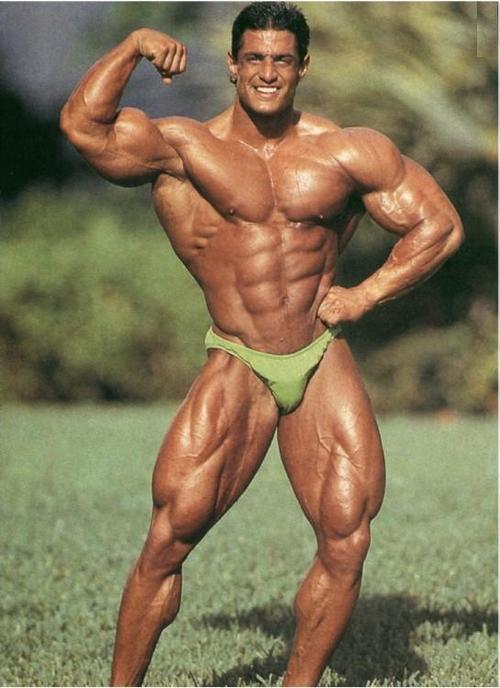
in a 1989 edition of Flex, Franco Santoriello, another young professional
bodybuilder, is described as 'a fissiparous freak of frightening size, a
perpetual shock wave of emotional tumescence that threatens to annihilate all
life forms that wander within the range of his fallout.' Adam Locks lists the
type of descriptions which bodybuilding publicity material would employ in
representing its stars: 'Freak-enstein, Meat Monster, White Buffalo, Freaky
Guns, Monster Mass, Jurassic Thighs, Thunder Thighs, Humungous Hams,
Cantaloupe-Size Delts, Titanic Thighs, Monstrous Delts, Bulldozer Quads, Canons
(for biceps), and Barn Door Shoulders (Locks, Adam [2003], Bodybuilding and the
Emergence of a Post Classicism).
What
we find expressed here is the celebration of abject freakishness: a
representational tactic which would become the norm for the world of
contemporary competitive bodybuilding.
Welcome
to the strategies of enfreakment used to market contemporary bodybuilding.
As
this book's introduction has detailed, there was a move in professional level
competitive bodybuilding from the ideal of the classical physique to the
disproportionate or "grotesque" physique. While the classical ideal
celebrated symmetry, proportions, and overall aesthetic harmony of the body,
the "post-classical body" is an inharmonious shape in which certain
parts have been distended so that they are too large and therefore overpower
the rest of the physique. Arguably, the first example of bodybuilding's
celebration of this body type was Tom Platz, whose extreme quadriceps
development overshadowed the rest of his body and managed to make even his hugely
muscled torso appear small. Possibly, Larry Scott was the first to anticipate
this move given the size of his arms, but it was Platz who became the first
main example of the post-classical physique. After Platz, bodybuilding
publications would marketing other bodybuilders having "freaky" and
grotesque muscle groups, including Eddie Robinson (famous for his arms), Dorian
Yates (famous for his enormous lats - back), and Platz's successor Paul
"Quadzilla" DeMayo. In other words, what was being sold to the
"fan" or "consumer" of bodybuilding representations was no
longer the pleasure of gazing upon a 'perfectible body' (Dutton, Kenneth [1995]
The Perfectible Body: The Western Ideal of Physical Development), but the
thrill of staring at a grotesque body. Indeed, terms which would enter into
bodybuilding currency would include 'monster,' 'grotesque,' 'gross,' and, most
importantly, 'freak.' From the late 1980s onwards, professional bodybuilding
was "sold" to the consumer through the representational strategy of
enfreakment.
What
is a "Freak"?
In
my last monograph, Transgressive Bodies: Representations in Film and Popular
Culture (2010), I suggested that the archaic entertainment spectacle of the
freak show has been creeping back into contemporary popular culture - if,
indeed, it ever left. The most influential writers on freakshows have been
Leslie Fiedler (1978), Robert Bogdan (1998), Rosemarie Garland Thomson (1996),
Rachel Adams (2001) and, most recently, Nadja Durbach (2009). One of the main
critical points to remember when considering freak shows is that the
"freak" is always a construct. The body may be different - for
example, it might be extremely tall - but it is the mechanism of the freak show
- the strategy of representation - which renders this body a "giant."
As Bogdan explains, '"freak" is a way of thinking, of presenting, a
set of practices, an institution - not a characteristic of an individual.' For
example, in most freak shows there was usually an exhibit entitled "the
giant." This was a man who was undoubtedly very tall, yet his tallness was
re-presented to the public as "giantism" and so the presenters would
usually have the "giant" wearing shoe lifts to give him another few
inches and a hat to add to the impression of extreme height, while the mise en
scene of the stage would also conspire to increase the illusion of even greater
height through the use of under-sized furniture. Likewise the "world's
fattest lady" always gained quite a few pounds in the program blurb and
through padding under the clothes. As Bogdan explains, in the freak show,
'every person exhibited was misrepresented to the public. The critic David
Hervey aptly describes this process of stylizing and, most importantly,
marketing the non-normative body as 'enfreakment.' (Hervey, David, [1992], The
Creatures That Time Forgot: Photography and Disability Imagery).
Of
course, the above debates raise the question of why spectators are still
interested (perhaps even more than they ever have been) in staring at
"freaks." Leslie Fiedler adopts a totalizing psychoanalytical
approach and makes the valid argument that freak shows bring to life our
darkest, most secret fears. For example, we stare (not look or gaze) at the
dwarf because this body touches our darkest fears about never growing up and
remaining a child forever. Yet this nightmare is made safe as it is removed
from us, contained within the representation (the freak show stage - or the
contemporary film/media text) and establishes a "them and us"
boundary. Nevertheless, as we stare at the 'freak" we shiver with anxiety
as we are reminded that this "difference" may not be as firm or
clear-cut as we like to imagine it is. (Fiedler, Leslie [1978] Freaks: Myths
and Images of the Secret Self).
Although
Fiedler makes a valid argument, psychoanalysis makes little allowance for
cultural variation (some cultures, given the specifics of its cultural history
may have a greater fear of the image of, say, "the fat lady" than
others) and also this does not suggest why "freaks" seem more popular
now than they ever have been. More recently, critics such as Margrit Shildrick,
Rosemarie Garland Thomson, and Rachel Adams have developed Fiedler's argument
by pointing out that the concept of the freak is a fluid one which continually
evolves in relation to cultural norms. In other words, the "freak" of
the dwarf may signify differently in relation to contemporary spectators than
the way it did for spectators of the Victorian freak show. As Adams points out
'the meaning of freaks is always in excess of the body itself' (Adams, Rachel
[2001] Sideshow USA: Freaks and the American Cultural Imagination). There is no
fixed meaning to the body of the freak because there actually is no essential
body which exists prior to the discourse which "creates" it. The freak's
body is the product of the institution or discourse known as the freak show. As
Thomson explains (Thomson, Rosemarie Garland - Cultural Spectacles of the
Extraordinary Body; Extraordinary Bodies: Figuring Physical Disability in
American Culture and Literature; Staring: How We Look), the freak show exhibits
become 'magnets for the anxieties and ambitions of their times'. These
'magnets' can function as abject sponges, absorbing all the fears and worries
of the particular period. As such, the signification of the "freaks"
and ways in which they have been exhibited have evolved over the years.
However,
why "freaks" may have returned in popularity in recent years may be
due to a growing realization on the part of the general public of the key
theory in body studies: that there is no fixed, inherent or essential body.
Arguably, the media's fascination with the "freak" body - the 500 lb
teenager; the woman with the most augmented breasts in the world; the
self-elective eunuch; the most beautiful transsexual in the world - is that
these images remind us (perhaps subliminally rather than explicitly) that the
body is not an essential attribute but instead is shaped by culture. A key
difference, of course, is that in recent years we have seen a growth in the minor
category of "freaks" which Bogdan (Freak Show: Presenting Human
Oddities for Amusement and Profit) identified as the 'self-made freak'. At the
heyday of the freak show, these were "freaks" such as the excessively
tattooed person, the person with innumerable piercings or the sword swallower
or the fire eater; in other words, bodies which had no physiological difference
but who enhanced/modified their bodies or forced their bodies to perform
extreme actions. Given advances in science, surgery, medicine, technology and -
most importantly for this chapter - exercise and nutrition, one of the things
we are witnessing is a growth in the category of the self-made freak. (Examples
of two famous self-made freaks have been the late Lolo Ferrari and the late
Michael Jackson). Therefore, what a documentary focusing on a woman with the
most surgically enhanced breasts in the world is not the terror of a freak of
nature but the horror of the overwhelming power of contemporary regimes of
culture in shaping the body. This documentary reminds us that the body is
formed through specific discourses and, in the case of a woman such as Lolo
Ferrari, shows us how frighteningly powerful these discourses can be. If these
discourses are the way the woman identifies - Lolo Ferrari, for example,
identified only in terms of her augmented mammary glands and was 'the woman
with the world's largest breasts' - then the body will be formed in accordance
with the cultural demands. Ferrari had to have more surgery to accede to the
ranks of having the most augmented breasts in the world. What Ferrari
demonstrated, in a nightmarish fashion, was how the human body was shaped
specific cultural discourses; performatively constituted by the discourse of
surgically enhanced breasts.
Arguably,
the same thrill is the case when we stare at the bodybuilding
"freaks" in the Mr. Olympia line-up. We marvel at the demands of
contemporary bodybuilding culture which has forced these bodies to develop to
such extreme proportions. While Schwarzenegger had competed in the Mr. Olympia
at about 230 lbs and at a height of 6'3", the 2010 Mr. Olympia - Jay
Cutler - weighs in at about 270 lbs at a height of 5'9". More than any
other contemporary activity, professional level bodybuilding testifies to the
overwhelming power of culture in shaping and coercing the human body to the
dictates of specific regimes.
However,
given that bodybuilding representations are hardly mainstream (a bodybuilding
training DVD will never make Amazon's top seller list), it is fair to say the fans
of these representations have considerably more investment and, in most cases,
identification in these "freak" bodies than a spectator who, surfing
through the television channels, stumbles across a documentary about a woman
with the most surgically enhanced breasts in the world. It is this
investment/identification which makes this particular strategy of enfreakment
markedly different from other contemporary representations.
Enfreakment:
Markus Ruhl

As
I have emphasized already, "freak" is a re-presentation (a
misrepresentation) of an unusual or non-normative body in which this body's
difference is coded as "freakish." Undeniably, the professional
bodybuilder quoted at the start - Mike Matarazzo - is an exceptionally
(unusually) muscled man who has body parts which are disproportionately bigger
than the rest of his physique. However, it is only the representational
discourse which renders this unusual body a "freak." In other words,
"freaks" only "exist" as re-presentations.
This
has particular relevance for bodybuilding given that (as outlined already in
the introduction to this part) the world of extreme, competitive bodybuilding
only exists for the majority of people as representations. These competition-ready
bodies, so stripped of fat and dehydrated that their veins look like snakes
slithering underneath paper-thin skin, only look this way for a short period of
time and so the majority of people only "know" this body because of
representations. Most competitive-level bodybuilders do not walk around in
public, flaunting their extreme muscularity in tank-tops and training vests but
tend to cover their vast bulk with loose clothes, known in bodybuilding circles
as "baggies." As Adam Locks points out, the bodybuilder, dressed in
baggies, looks to the general public as someone who is merely bulky or fat and,
as we all know, in our contemporary culture of fast-food plenty, bodies which
are bulky or "overweight" are hardly unusual, let alone warranting
the status of "freak."
Bodybuilding
representations, however, have strained to represent the extremely muscular
body as a "freak." One contemporary star of the professional
bodybuilding circuit, who has been subject to bodybuilding culture's strategies
of enfreakment, has been the German bodybuilder Markus Ruhl, an athlete
(in)famous for the sheer enormity of his physique. Although never having been
crowned Mr. Olympia, Ruhl continues to attract a legion of fans enthralled by
the huge dimensions of his body. Jon Hotten (Muscle: A Writer's Trip Through a
Sport With No Boundaries, 2004) employs enfreakment discourse to describe Ruhl
as having 'no real neck to speak of, although there must have been one
somewhere. His lats were so big his arms had nowhere to go but outwards. His
thighs moved past one another like two men in a narrow corridor.' Indeed, it is
hardly surprising that Ruhl's nickname is 'Das Freak.' In a description of the
free-posing round of the Mr. Olympia, one journalist describes Ruhl as 'Das Freak!
One of the more popular bodybuilders to grace the posing dais in recent years.
Ruhl was his usual beastly self. Freakish, hard and separated, Markus is
finally getting his props and deserved his placing.' This element of Ruhl's
freakishness is the way bodybuilding publicity material always
"markets" his body, especially in his lifestyle DVD.
Lifestyle
DVDs are publicity material for professional bodybuilders. These documentaries
are, unsurprisingly, composed of sequences of the bodybuilder training in the
gym, and talking about his exercise regime and diet, but will also feature
sections which represent the athlete in his recreational leisure time. In
Ruhl's first publicity DVD, Markus Ruhl: Made in Germany, the documentary
features all the usual sections of gym training, nutrition, and competition
preparation but also includes a rather entertaining segment entitled 'Ruhl Goes
Shopping,' which represents Ruhl and his wife, Simone, out shopping for their
groceries in the local supermarket. http://www.youtube.com/watch?v=mAOuIqXJwb0
The
humor of this sequence is observing the stares which Ruhl receives from all the
other shoppers. As the sequence begins, Ruhl, dressed in training tank-top and
workout pants, lumbers along the aisle pushing his shopping trolley.
Diegetic
"musak" plays, suggesting the everyday banality of the situation. It
is also intended to suggest the "virtual-realism" of the sequence and
to downplay that this is an "enfreakment" marketing scenario, used to
sell the image of Ruhl to bodybuilding consumers. As Ruhl swaggers around the
supermarket, filling the trolley with huge quantities of groceries, he manages
to turn every head in the place as people stare in astonishment, unable to
fathom what this body actually is. Some people giggle, some simply stare and a
few more arrogant individuals feel it is their right to make jokes about the
man's extreme proportions. The sequence culminates in Ruhl queuing at the
check-out while a woman standing at the next queue is visibly nauseated by the
sight of Ruhl's body. The woman makes the classic "stifling vomit"
face and clasps her hand to her mouth as if to stop herself from puking. It is
interesting that this particular moment was deemed so important to the whole
documentary that it was used in the trailer and, should the spectator fail to
notice that a woman was nauseated at the sight of Ruhl's "monstrous"
body, this was even highlighted on the screen by an arrow superimposed onto the
image.
Of
course, one way of interpreting the shopper's stares is to rad their
astonishment due to a masculine invasion of a gendered space. Some could argue
that Ruhl's shopping is a hyper-masculine invasion of a feminine space and
therefore this produces horror, if not even nausea, by the female occupants.
Since the iconic ending of The Stepford Wives, in which a troupe of gorgeous,
pre-feminist women (or are they androids? - we never really know) navigate
their way around Stepford supermarket in a sequence of such beauty that it
almost looks like a finely choreographed ballet, the supermarket may be read as
an exclusively feminine space. In this respect, the 'shopping sequence' is
almost akin to a masculine invasion of the feminine. This (arguably)
hyper-masculine body invades a space which is normally a safely feminine haven
and intimidates, if not even terrorizes, female shoppers.
However,
reducing the supermarket to an exclusively feminine space is, in contemporary
culture, not accurate. It hardly requires a quantitative investigation to
discern that supermarkets are now frequented by men as well as women although,
certainly in some areas, the majority of shoppers will undoubtedly be female.
Instead of viewing the supermarket as indicative of femininity, it is probably
more appropriate to consider it in terms of the banal, the everyday or, more
importantly for these debates, the normative.
Therefore,
I read the 'Ruhl Goes Shopping' sequence in the DVD as a celebration of how
this body no longer 'fits' (quite literally in his case) into the regimes of
the normative. Through his intense program and training and supplementation
Ruhl is represented as having built a body which has transcended the everyday
and therefore upsets the normative bodies of the supermarket who find his body
impossible to read. In this respect, extreme bodybuilding is represented as
attempting a form of deconstruction, offering a challenge to accepted ideas of
beauty.
Arguably,
extreme bodybuilding could be related to other body modification practices such
as tattooing and body piercing. Like bodybuilding, tattooing and body piercing
can be interpreted as a form of resistance, critiquing (often through
caricature) culture's notion of normative beauty. In one respect, what the
extreme body-piercing practitioner does is to take something which is deemed
attractive or ornamental by contemporary culture (pierced ears are usually
regarded as attractive ornamentation) and then caricature this through
excessive piercing. Pierced ears are deemed "sexy" by normative
Western culture but what if nose, lips, cheeks, and eyebrows have piercings in
them as well? Similarly, tattooing can have a comparable trajectory. If
contemporary Western society deems one subtle tattoo to be a risqué, quirky
ornamentation, what about when the body becomes covered with these "ornaments"?
Arguably,
a comparison could be drawn between the politics represented by the hyperbolic
body of the extreme bodybuilder and another embodiment of cartoonish
dimensions: the late Lolo Ferrari. Ferrari was a Belgium porn star who attained
a relative degree of notoriety for having (while she was alive - I believe she
has been succeeded now) the most surgically enhanced breasts in the world. She
sprang to media recognition largely because of her regular appearances on the
British television show Eurotrash where she did very little else other than
flaunt her enormous breasts for the spectator's attention. Ferrari's slot on
Eurotrash was entitled "Look at Lolo" and every week spectators would
marvel at hos such an extreme body could manage to do a basic chore such as
polish the silver or wash a car. Ferrari's breasts were indeed
"freakish." After a huge number of operations (18-25 - reports vary),
Ferrari had indeed attained the dimensions of a living Barbie doll. Reports
(but, again these may simply be 'enfreakment' marketing ploys) suggest that she
suffered intense back pain, from supporting the weight of the breasts, and had
trouble sleeping at night. Ferrari died of a drug overdose - or so the reports
suggests, but this is open to debate and many believe that her husband was
implicated in her untimely suicide. While most critics would simply dismiss
Ferrari as a woman suffering from serious mental health issues, most obviously
body dysmorphia, Meredith Jones (in Body and Society) makes some very interesting
points about the politics of Ferrari's cartoon dimension breasts by suggesting
that Ferrari's surgically enhanced body can be read as transgressive. By having
attained the dimensions normally associated with a Barbie doll, or a masculine
fantasy cartoon, Ferrari is actually making an ironic comment on the
"perfect" woman's body. If society deems the extreme dimensions of
tiny waists and enormous breasts as the feminine ideal, the representations of
Ferrari ask how attractive it is when when these dimensions are exaggerated to
cartoon proportions. As Jones points out, 'Ferrari was quite aware of the
borders she was transgressing' as something deemed ideal in feminine beauty can
become very unattractive, if not even ugly, when it reaches excessive dimensions.
In this respect, Ferrari was enacting a form of femininity that was 'overly
subversive'. Like the extreme bodybuilder, Ferrari can be read as a 'freak of
conformity' in that she takes something which is deemed ideal in contemporary
culture but twists or even carnivalizes it.
Arguably,
the extreme bodybuilder can be read in a similar fashion. This celebration of
the 'freakish' body, a body which has pushed idealized proportions to a
ridiculous extreme, can be read as making a subversive comment on idealized
masculinity. Most importantly, as the 'Ruhl Goes Shopping' sequence
demonstrates, male bodybuilding is represented as celebrating a rejection of
traditional ideas of attractiveness.
Of
course, a comparison with Lolo Ferrari obviously ignores the issue of gender.
When a man challenges regimes of masculine attractiveness/beauty it is not the
same cultural taboo as when a woman does it. While women have always been
considered simply as their bodies, and their appearances have always been
policed by patriarchal culture, men by contrast have had the liberty (until
recently) of not having to be overly concerned about their appearance. The male
body is a tool for getting the job done but never something that should be the
cause for concern about whether or not it is beautiful (Bordo, Susan [1999] The
Male Body). Yet this links to one of the tensions within bodybuilding in that
the appearance of the body is the ultimate goal of the bodybuilder. Unlike
powerlifting or weightlifting, which are concerned with the ultimate heavy
lift, irrespective of how this alters body's appearance, bodybuilding is not
concerned with the amount of weight lifted as long as it effects changes in the
physique. Therefore extreme bodybuilding stands as a curious activity given
that its concern is purely appearance - the bodybuilder works out to create a
specific body shape and not to achieve maximum strength - but that this
"appearance" is excessive and unattractive by contemporary culture.
It
is important to remember that the sight of Ruhl's body is represented as
managing to evoke nausea in a woman queuing at the checkout but yet this abject
spectacle is represented to the bodybuilding fan (who, arguably, wants to copy
Ruhl's training and nutrition so that he too can look like that) as something
desirable. Therefore, it is not rather odd that this sequence proclaims to the
bodybuilding fan that looking like Ruhl will only lead to public shame and
ridicule? If you look like this, everyone will stare rather than gaze. To
reference Matarazzo once again, you will be an 'object of ridicule' and a
'grotesque, horrifying freak.' It is here that I wish to consider how these
enfreakment representation strategies fuel fantasies of bigorexia in the
bodybuilding fan.
Bigorexia

The
term 'bigorexia' is derived from the established medical term known as anorexia
nervosa. While the anorexic believes that the body is too fat, the bigorexic
believes that the body is too skinny and seeks to increase overall (muscle)
bulk. Obviously, there are very different political and psychological agendas
between anorexia and bigorexia which I consider in more detail later.
However,
there is still some debate about the term bigorexia itself given that some
critics use it as a synonym for "The Adonis Complex" while others,
myself included, draw a distinction here. The Adonis Complex was a term made
famous by the trans-academic text of the same name which argued that more and
more men are now feeling victim of the beauty myth of contemporary culture. Besieged
by images of perfected bodies and six-pack abs in every advertising image, men
are starting to feel the tyranny of impossible standards of beauty in a way
previously experienced only by women. One of the most interesting examples
cited in the Adonis Complex has been the recent transformation in the physiques
of boys' toy dolls - especially action figures. The original GI Joe, Luke
Skywalker, and Hans Solo had body types which could be deemed
"average." By contrast, contemporary models of these toys now display
pumped biceps and washboard stomachs. This fetishization of chiseled
muscularity in popular culture has, arguably, exerted an influence on male body
image and induced an obsession with the appearance of the body in a fashion
similar to those which women have labored under for years.
Yet
I should draw a distinction between the Adonis Complex and bigorexia. While the
Adonis Complex aspires to a body type which is deemed beautiful by the
standards of contemporary culture, bigorexia fetishes "extreme"
muscle mass, often to the point of excess, which moves the body beyond the
spectrum of traditional attractiveness. The bigorexic reveres Markus Ruhl or
the other "mass-monsters" of the professional bodybuilding circuit
while someone consumed by the Adonis Complex aspires to the
"beautiful" dimensions of a Calvin Klein model. In this way bigorexia
can be read as relating, in some respects, to anorexia although there are
definite political differences.
On
an obvious level both bigorexia and anorexia are about the subject gaining
control of the unruly, wayward body. Many people who suffer from anorexia often
feel that their lives are out of control and the only thing that they actually
can control and discipline is the living tissue of their bodies. Bodybuilding
obviously holds a similar trajectory which explains its popularity in prisons,
and other establishments where civil liberties are denied, and also areas of
socioeconomic deprivation. As Susan Bordo explains, like anorexics,
'bodybuilders put the same emphasis on control: on feeling their life to be3
fundamentally out of control, and on the feeling of accomplishment derived from
total mastery of the body' (Unbearable Weight: Feminism, Western Culture, and
the Body [1993]). Yet there is another area deserving attention in the
similarity between the two - the correspondence these activities have to sexual
attractiveness and the awareness the subject has of this. Although, on the one
level, anorexia can be read as women simply trying to adhere to the standards
of beauty found on the contemporary catwalks (where womanly curves have been
replaced by reed-thin, if not skeletal-thin, models), it is also possible to
see anorexia as a form of resistance. Many anorexic women talk about hating the
sexual characteristics of their body. Bordo quotes an interview with one
anorexic woman who describes how, at puberty, she hated the development of her
womanly curves and other sexual attributes such as full breasts. Indeed, many
anorexics express a desire to be removed from the constrictions of sexuality
altogether and of remaining in a time (childhood) where sexuality was not an
issue.
Arguably,
this idea of being removed from the dictates of sexuality is also at work in
the agenda of the extreme bodybuilder or bigorexic. While the anorexic wishes
to subdue her womanly curves so that she is not recognized as a sexual subject,
and not driven uncontrolled sexuality herself, the bigorexic wishes to step
outside the regimes of sexual attractiveness too but obviously in a much more
confrontational, aggressive fashion. The anorexic wants to become small and
unnoticed; the bigorexic wants to become so "gross" that he is
unfathomable within the dictates of sexuality. This is why bodybuilders such as
Troy Zuccolotto (quoted at the start) express a desire to disgust people, to
the point of puking, by his enormous, grotesquely muscled physique. Certainly a
distinctly different agenda from that expressed by someone held in the thrall
of the Adonis Complex, idolizing the beautifully sculpted musculature of an
Abercrombie and Fitch model.
One
of the most outspoken ambassadors of bigorexia is bodybuilder Greg Valentino.
Known for having the biggest arms in the world, Valentino is famous for a very
disproportionate physique (the arms are far too big to be in any way
proportionate to the rest of the physique), and, more recently, for the trauma
his arms suffered as documented in The Man Whose Arms Exploded. In the film,
Valentino explained that he wanted to have the biggest arms in the world so
much that he not only performed site injections of steroids (injecting steroids
directly into the biceps muscle) but also pumped huge amounts of an oil known
as synthol into the muscles in order to inflate them to enormous proportions.
Unable to cope with the sheer volume of synthol, Valentino's arms, quite
literally exploded when his immune system decided it could no longer tolerate
this foreign oil being pumped into the body. His biceps developed internal
abscesses which eventually burst and oozed out. This rather disgusting image -
indeed it would not be out of place in a gross-out horror movie - has delighted
and intrigued many fans, most notably teenage boys. Valentino has appeared
regularly in teenage, gross-out lad magazines such as Nuts and Zoo which often
delight in the horror of exploding bodies, pus and gore, and also the
scatological delights of piss and shit. These abject substances are, of course,
notoriously the fascination of prepubescent boys who often delight in all
things disgusting and gross, especially when they are the cause of the disgust
themselves. In the documentary about steroid use in American sports, Bigger,
Stronger, Faster, Valentino explains that he was not interested in bodybuilding
to make himself more attractive to women. Indeed, with a grin of satisfaction,
Valentino proclaimed that his arms are disgusting and put women off. His face
breaks into a beaming smirk when he describes how women look at his arms and
think 'Gross.'
This
rejection of sexual attractiveness, of building a body which is outside the
regime of sexual allure, obviously accords with the anorexic's trajectory of
preventing the body from being sexual. Of course, the anorexic tries to prevent
the development of sexual features while the bigorexic seeks to exaggerate
features which are deemed sexy, such as gym-sculpted biceps, and caricature
them to an unattractive extreme. It could be suggested (although without
ethnographic research this is speculative) that bodybuilding representations
therefore support homosocial fantasies in which men create their bodies to
impress other men and disgust women. In this respect, it is hardly surprising
that the most avid fans of bodybuilding are pubescent boys, being at extremely
difficult points in their lives - the onset of hormones, lust and the
"threat" of girls - may find some solace in the fantasy
representations of bodybuilding as "removed" from the dictates of
conventional sexual attractiveness. Arguably what can be interpreted from the
representations - or rather enfreakment fantasies - of bodybuilding imagery is
the dream of a petulant rebellion against societal norms. The bigorexic is
saying he will not conform to this tyranny of making his body conform to
dictates of masculine attractiveness - will actively reject the tyranny of the
Adonis Complex - but will make his stand of resistance through the very
mechanisms which the Adonis Complex says men should do; namely, gym training
and bodybuilding.
Why
the Move to Bigorexic "Freak" in Contemporary Bodybuilding?
The
question this "look" raises is why the change in iconography of
bodybuilding representations? From representations which had revered the
proportions of classical beauty they have become images which glorify the
"grotesque" and the "freaky." The reason for the change
might be attributed to various developments in the sport and fitness industry
and cultural politics.
First,
a factor which has undoubtedly influenced the extreme hypertrophy of
contemporary male bodybuilding physiques is the development outlined in this
book's introduction: the growth in popularity of women's bodybuilding and, most
importantly, the change in female bodybuilding physiques. Indeed, while the
developments in nutrition, pharmaceutical enhancements, and training techniques
promoted changes in the physiques of male bodybuilders, it also permitted
extreme advancements in female physiques. As female bodybuilding started to
change, with female bodybuilders attaining a degree of muscularity which
previously was considered only possible for a male body, male bodybuilding had
to progress alongside it.
Second,
the late 1980s saw the growth of a new strand of male body type springing into
public view. This was a more lithely muscled, toned and, most importantly,
eroticised body which came to grace the cover of other alternative health and
fitness magazines and started the cultural trend already described in 'The
Adonis Complex.' As Susan Bordo summarizes, by the late 1980s, 'beauty
(re)discovers the male body.' Eventually this type of body would be canonized
as the Men's Health magazine physique - a body which is distinguished by its
sculpted abs, low body fat and most importantly moderate muscle development.
The rise in popularity of this body type was connected to the growth of the gym
and fitness industry. While gyms had previously been filthy, underground
bunkers (often tagged onto a boxing club), in the 1980s they became luxurious
health clubs and gym membership became a standard work bonus for white-collar
professionals. Now, having a lithely muscled physique became the goal of the
average professional who would often train after his day at the office.
The
rise in popularity in the Men's Health-type physique meant that bodybuilding -
as a competitive sport - had to assert itself as something different or more
extreme from this body type. With advancements in training, nutrition, and
pharmaceutical drugs (where once steroids were the only chemical recourse,
growth hormone, insulin, and others were also being used), competition level bodies
started to become more extreme and pushed the envelope out in relation to
muscular development.
However,
the key factor which is certainly implied in the above discussion of the Men's
Health physique and the Adonis Complex is the question of who is doing the
gazing and whether or not this is underpinned by eroticism. As I have argued
already, the investment in the "freakishness" of extreme bodybuilding
fuels fantasies of being released from the pressures of the conventional Adonis
Complex and of sexuality altogether. The subject fantasizes about challenging
these pressures in deconstructive, confrontational fashion rather than simply
ignoring them and being accused of "letting himself go." Similarly
though, one of the reasons why contemporary bodybuilding has embraced the idea
of "freakishness" may well be its paranoid attempt to extricate
itself from the connotation of homoeroticism.
Bodybuilding
has always held an uncomfortable relationship with gay culture. One of the most
famous early "muscle" publications was Bob Mizer's mail-order
Physique Pictorial. This magazine was soft porn masquerading as an exercise
magazine, and featured young toughs as its models (often just out of prison)
whose physiques ranged from "some" muscular development to none at
all. One of the reasons why gay soft porn stopped disguising itself as a
bodybuilding publication was simply the question that the pornography
legislation changed in the 1970s and porn could now legally exist. No longer
did porn fans have to buy publications which claimed to be dedicated to
"sun bathing enthusiasts" and but could buy actual pornography.
Indeed, one of the Weiders' biggest struggles - and their bodybuilding
ambassador Arnold Schwarzenegger was very important here - was to free
bodybuilding from the taint of homosexuality. Schwarzenegger's indisputable
heterosexuality and charisma greatly helped in erasing the stigma of bodybuilders
as closet gays.
However,
the rise in the 1980s of gay pornography, which became a mulit-million dollar
enterprise, reified the representation of the classical bodybuilder's physique
as ultimate object of homoerotic desire. While images of bodybuilders engaging
in homosexual activities had previously been the stuff of fantasy drawings,
such as those produced by Tom of Finland, now these could be watched on home
videotape. Of the gay pornography studios, Falcon became synonymous with the
bodybuilder look and often featured impoverished amateur bodybuilders having
sex with other bodybuilders. Of course, these bodybuilders had more in common
with the type of physique predating Schwarzenegger than with the "mass
monster" or "freak" of the 1980s competition world. (This, of
course, was why they were impoverished, as their physiques had not attained the
"freakish" proportions necessary to gain entry to the professional
ranks.) Therefore, while the classical physique was being crowned as the ultimate
in homoeroticism, with gay men (especially those based in metropolitan
settings) taking up bodybuilding as a serious hobby, professional bodybuilding
needed to distinguish itself from that look and so espoused the excessive,
grotesque physique.
Another
factor in this debate may well have been the lasting impact of early 1980s
professional bodybuilder Bob Paris. Paris was (and still is) the only
professional bodybuilder to have taken the very brave step of announcing his
homosexuality to the bodybuilding world. A noted writer and critic Paris has
written a considerable amount about his experiences of professional
bodybuilding and has always maintained that "coming out" was damaging
for his career. As the only openly gay professional bodybuilder, Paris has
attained iconic status within gay culture. For example, London's most famous
gay gym is The Paris Gym, although, sadly, many of the gym-goers training in it
nowadays are unlikely to be aware of the significance of the gym's name. Yet
Paris is not only famous for being openly gay identified but also for arguing
that the classical physique should remain the goal of professional
bodybuilding. Writing about the shift in professional bodybuilding toward
freaky, grotesque proportions in Straight From the Heart: A Love Story, Paris
argued:
- By the time I had stopped competing, I hated
bodybuilding and the direction it was headed in. And, in fact, I still disagree
with the direction the sport was and is taking. I saw bodybuilding as a road
toward the 'perfect' physical specimen. The dominant culture of the sport for
the last ten years has been grotesque freakiness for the sake of freakiness.
(1994)
What
this did, of course, was help cement the link between the classical body and
homosexuality. If Paris, an openly gay man, exalted the "beauty" of
the classical physique, then most people interpreted that this was a look which
appealed to gay men. If bodybuilding was not to be a homoerotic beauty pageant,
then it needed to transform the look of the bodies on the stage. Indeed, this
emphasis on how a bodybuilding competition should not be read as a beauty
contest, and how those men were not hunk pinups, was exemplified by one of the
most popular "mass-monsters" of the late 1980s/early 1990s - Nasser
el Sonbaty. The journalist Jon Hotten described Sonbaty as having 'the head of
a professor . . . and the body of a genuine freak.' Sonbaty did indeed have the
stereotypical head of the professor even in the strictly physical sense given
that he was balding - yet did not simply shave the head but emulated a style
which was not far from being labeled a "comb-over" - and always wore
a pair of big, thick specs - even on the competition stage. Sonbaty's specs
were not fashion glasses but heavy, unglamorous spectacles. Yet beneath this
professorial-looking head was a physique which, at a height of 5/11",
often weighed an astonishing 300 obs plus. Sonbaty's appearance certainly made
the point: professional competitive level bodybuilding is not a beauty contest
and the contestants on stage are not hunk pinups.
Conclusion
This
chapter has argued that in order for professional-level bodybuilding to survive
it had to change its strategy of publicity representations and market itself as
a postmodern freak show. Given the rise in female bodybuilding, the cultural
trend of the Adonis Complex, and the growing articulation of a metropolitan gay
bodybuilding culture, contemporary professional bodybuilding had to repackage
itself as something different from the canonization of male beauty. Enfreakment
discourse became the accepted way of marketing professional bodybuilders to the
fans. I have suggested that these representations may fuel homosocial,
bigorexic fantasies for the bodybuilding fan; the idea of challenging regimes
of normative attractiveness and creating a body which moves outside the
dynamics of sexuality altogether.
However,
it should be remembered that, historically, the freakshow was a place where
human deviance was valuable, and in t hat sense valued. Joshua Gamson points
out that this "value" is the way in which the "freak" can
challenge received dictates of normativity (Freaks Talk Back: Tabloid Talk
Shows and Sexual Nonconformity). Indeed, Gamson argues that one contemporary
evolution of the freak show - the daytime chat show - is not simply a vehicle
for permitting normative people to stare at the freaks but can also be read as
spectacles which 'mess with the "normal," giving hours of play and
often considerable sympathy to stigmatized populations, behaviors, and
identities, and at least pertly muddying the waters of normality' which,
arguably, intrigues most critics interested in enfreakment.
Perhaps
the final word should be with Greg Valentino who in his own charming style
states that the fans of bodybuilding demand the disquieting pleasure of
watching "freaks":
- In bodybuilding nobody gives a shit about
Milos Sarcev up there all symmetrical with a beautiful body. You ask the crowd
who they like to see. They like to see the freaks, Markus Ruhl of Paul Dillet,
even though he can't pose to save his life. People love to see mass. They like
to see freaks. It's what gets them into this sport.
And
what the fans want - the fans shall get.